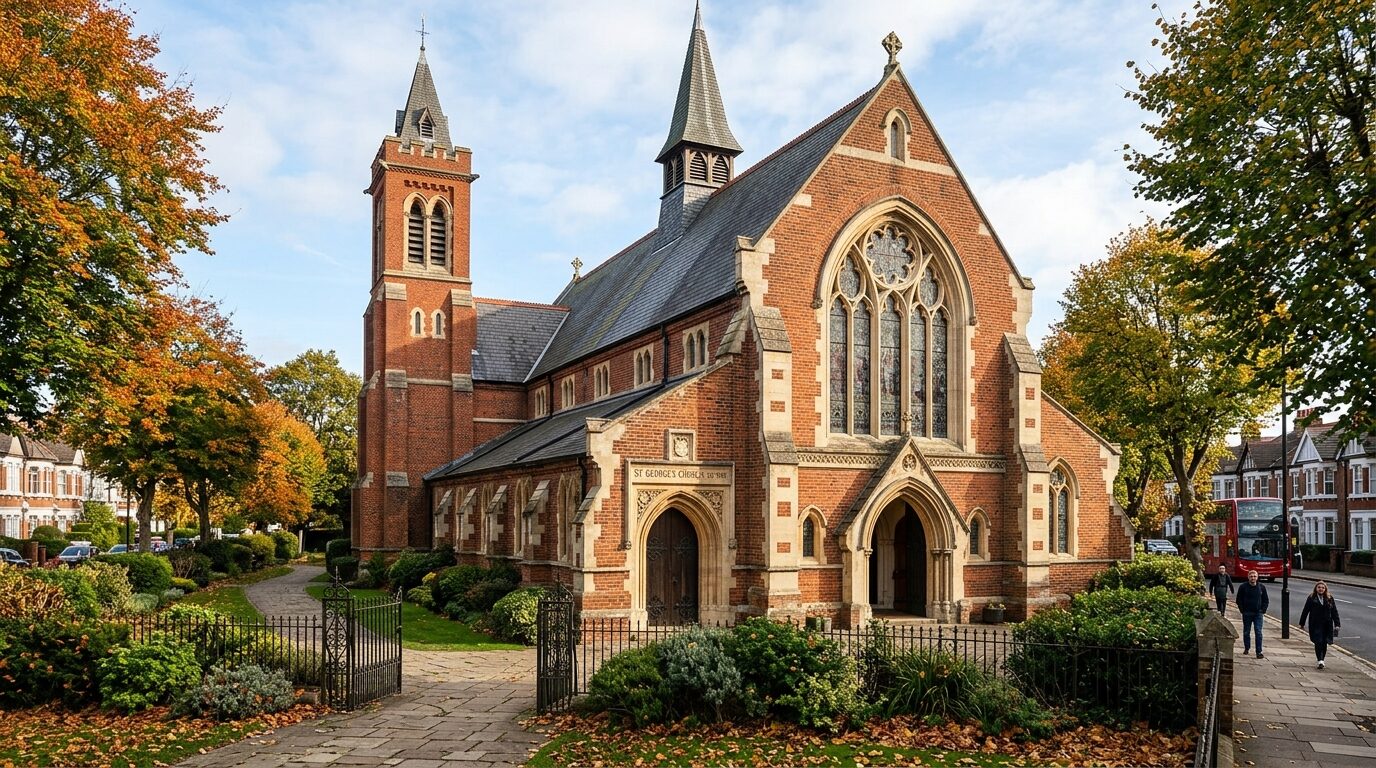
Standing quietly at the corner of Warwick Road and St Stephen’s Crescent, St Stephen’s Church has served as a resilient spiritual anchor and architectural landmark on the boundary between Norbury and Thornton Heath for more than a century. Dedicated to the first Christian martyr, the Grade II listed building is celebrated locally for its imposing red-brick and stone architecture, its rich liturgical heritage, and an intriguing structural quirk: a grand bell tower designed by a master ecclesiastical architect that was never completed.
While commuters and neighborhood strollers pass its substantial nave daily, the history of St Stephen’s tells the story of early twentieth-century suburban expansion, ambitious Edwardian craftsmanship, and an enduring civic devotion to community care in northern Croydon.
Edwardian Ambition and the Architect W. Samuel Weatherley
At the opening of the twentieth century, the rapid growth of South London’s suburban railways and electric tramways drew thousands of working and middle-class families south from central London. Housing developments quickly transformed the agricultural meadows between London Road and Green Lane into quiet residential avenues. To meet the spiritual and social needs of this expanding community, church leaders set out to establish a substantial permanent church building.
The foundation stone of the present building was formally laid in 1908, and following four years of dedicated construction, the church was consecrated in 1912. The building was designed by W. Samuel Weatherley, an accomplished architect renowned for his sensitive Gothic Revival work, ecclesiastical furnishings, and collaborations on prominent Victorian and Edwardian parish churches across Britain.
Architectural Grandeur and the Missing Tower
Weatherley designed St Stephen’s on a generous civic scale. The interior features an expansive four-bay nave supported by robust stone piers and arches. The continuous roof extends seamlessly from the nave across a rood screen to form an elevated chancel and sanctuary, creating remarkable internal acoustics and dramatic vertical sightlines. A chapel in the south aisle features fine stained glass windows, while mono-pitched roofs over the side aisles lend the exterior an elegant, stepped silhouette.
Yet St Stephen’s holds one visible mystery that catches the eye of architectural historians: its missing tower. The original architectural blueprints called for an imposing bell tower over the west entrance, and workmen successfully laid the massive foundations and initial stone base steps. However, due to funding constraints and the looming shadow of the First World War, the tower was never carried up to its intended height. Rather than detracting from the church, this unfinished element gives St Stephen’s its distinctive local character, reflecting the changing fortunes of early-twentieth-century London.
Modern Heritage and Community Action
Recognised by Historic England as a Grade II listed building, St Stephen’s has adapted thoughtfully over decades of changing community life. In 1985, sympathetic internal reordering introduced a nave altar to bring services closer to the congregation, complemented by enhanced high-level architectural lighting that highlights the timber ceiling.
Operating in the modern Catholic tradition of the Church of England, the parish has maintained a strong civic mission, establishing itself as an inclusive community space welcoming residents of all backgrounds. In addition to regular Sunday worship, the church plays an active role in local relief, coordinating regular non-perishable food collections for South London food banks and providing meeting space for grassroots groups and music initiatives.
Practical Information for Visitors
- Address: Warwick Road, Norbury / Thornton Heath, London CR7 7NH (junction with St Stephen’s Crescent).
- Heritage Listing: Grade II listed building (Historic England).
- Parish: Diocese of Southwark (Croydon North Deanery).
- Transport Links: Approximately a 10-minute walk from both Norbury and Thornton Heath National Rail stations; serviced nearby by bus routes 50, 109, and 250 stopping on London Road and Green Lane.
- Services and Inquiries: Weekly parish service times, hall hire details, and community initiatives are published on the church’s official website (ststephensnth.co.uk).
Standing through more than a century of change, St Stephen’s remains a dignified testament to Norbury’s Edwardian heritage—an unfinished architectural vision that grew into a fully realized community haven.