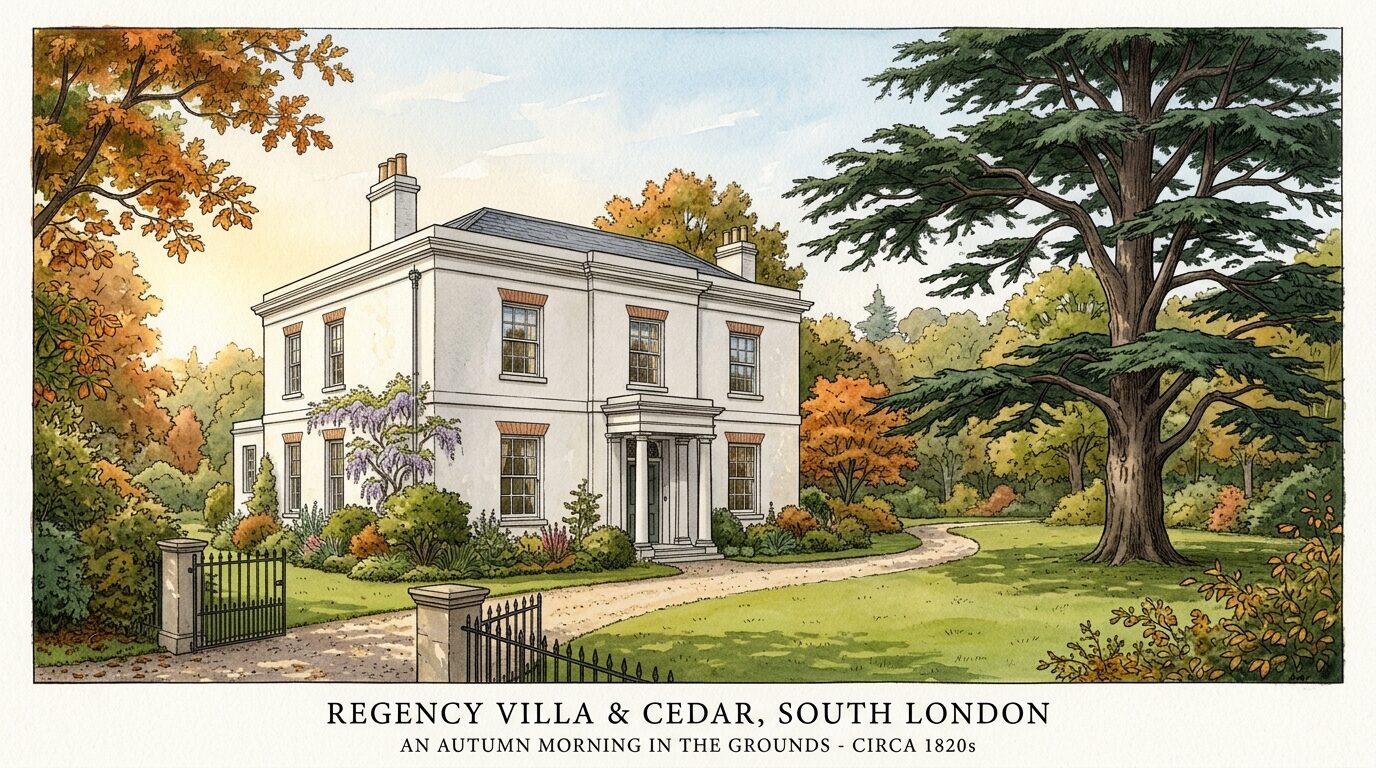
Nestled along the wooded slope above Craignish Avenue, Norbury Hall stands as one of SW16’s most significant surviving Regency estates. Built in 1802 as an imposing stuccoed manor house, the estate once commanded sweeping vistas across the Surrey countryside, complete with extensive ornamental parkland, a carriageway sweeping in from London Road, and a lake supplied directly by the River Graveney.
While the surrounding eight-acre grounds now serve as the beloved public park affectionately known to generations of local residents as “Squirrel Park,” the story of the house itself chronicles two centuries of suburban transformation—from wealthy merchant country seat to the historic birthplace of London’s pioneering municipal electric tramways.
The Creation of a Regency Country Estate
At the turn of the nineteenth century, Norbury was a rural agricultural hamlet of rolling meadows, market gardens, and scattered country seats situated well outside London’s metropolitan sprawl. In 1802, businessman William Coles commissioned the construction of a substantial two-storey country residence, originally known as Norbury House. Designed in the dignified classical Regency style, the mansion featured crisp stucco facades, tall double-hung sash windows, a pedimented porch, and a slate hipped roof.
Coles landscaped the expansive grounds with grand cedar trees, sweeping lawns, and an artificial ornamental lake fed by diverted waters from the nearby River Graveney. Over the subsequent decades, the estate passed through prominent Surrey families, including Benjamin Aislabie, an influential wine merchant and cricket administrator who served as the first honorary secretary of the Marylebone Cricket Club (MCC) at Lord's.
The Stanton Era and Tramway Pioneer Sir Clifton Robinson
In the mid-nineteenth century, the estate was acquired by George Stanton, an agricultural landowner whose tenure gave the mansion its alternative historic name: Stanton House. Stanton enlarged the grounds and maintained the estate's picturesque woodland borders even as speculative development began approaching from Streatham.
By the dawn of the twentieth century, the property came into the hands of Sir James Clifton Robinson (1848–1910), a visionary transport engineer celebrated as “The Tramway King.” Robinson was instrumental in designing and constructing early electric street tramways across London, Bristol, and Dublin. Under Robinson’s ownership, the house was formally renamed Norbury Hall.
Robinson made Norbury Hall both his family residence and a hub of late-Victorian and Edwardian transport innovation. From his SW16 study, Robinson oversaw the ambitious expansion of the London United Tramways and worked alongside the Croydon Corporation Tramways system, which brought electric tramlines directly down London Road to Norbury terminus in 1901.
From Private Grounds to Public Sanctuary
Following Robinson’s death and subsequent residential development across western Norbury in the 1920s and 1930s, the estate faced potential parcelisation. However, in 1956, the local authority acquired Norbury Hall and its grounds to secure the historic property for civic welfare.
Recognising that the vast formal grounds were too extensive for a residential care home to maintain alone, the municipality divided the estate:
- The Mansion: Converted into a high-dependency residential home for elderly residents, ensuring the preserved Georgian fabric retained a dignified, caring civic mission.
- The Grounds: The eight-acre formal gardens, specimen tree groves, and former lake basin were transferred to the municipal parks department, opening permanently to the local public as Norbury Hall Park.
Historic Landscape Features Surviving Today
Although the original ornamental gazebo was tragically lost to arson in 2002 and the Graveney-fed lake was drained in the mid-twentieth century, substantial living links to the 1802 estate remain visible for sharp-eyed visitors:
- The Great Cedar of Lebanon: Near the mansion boundary stands an enormous specimen cedar dating back over two centuries, carefully protected and tended by community volunteers.
- The Graveney Lake Basin: A shallow, grassy concave depression in the lower park clearly marks the outline of the Regency lake, which still occasionally collects water during prolonged winter rainfall.
- Specimen Tree Canopy: Mature Victorian conifers, copper beeches, rhododendrons, and sweet chestnuts continue to frame the historic boundary walks.
Community Care and Conservation
Today, Norbury Hall remains in continuous use as an elderly care facility, safely enclosed from the public park. The surrounding green space is actively nurtured by the Friends of Norbury Hall Park, a dedicated volunteer group formed in 2017.
Through regular monthly working bees, the Friends maintain floral beds near the historic manor boundary, protect local wildlife habitats, and ensure that one of Norbury’s foundational Regency landscapes continues to thrive as an accessible open haven for all SW16 residents.
Heritage Information for Local Walkers
- Location: 52 Craignish Avenue, Norbury SW16 4RN (pedestrian entrances via Craignish Avenue and Ederline Avenue).
- Public Access: The eight-acre public park is open year-round during daylight hours. Note: Norbury Hall mansion is a private residential care facility and is strictly not open to the public.
- Transport Links: Approximately a 7-minute walk eastward from Norbury National Rail Station; accessible via bus routes 50 and 109 along London Road.