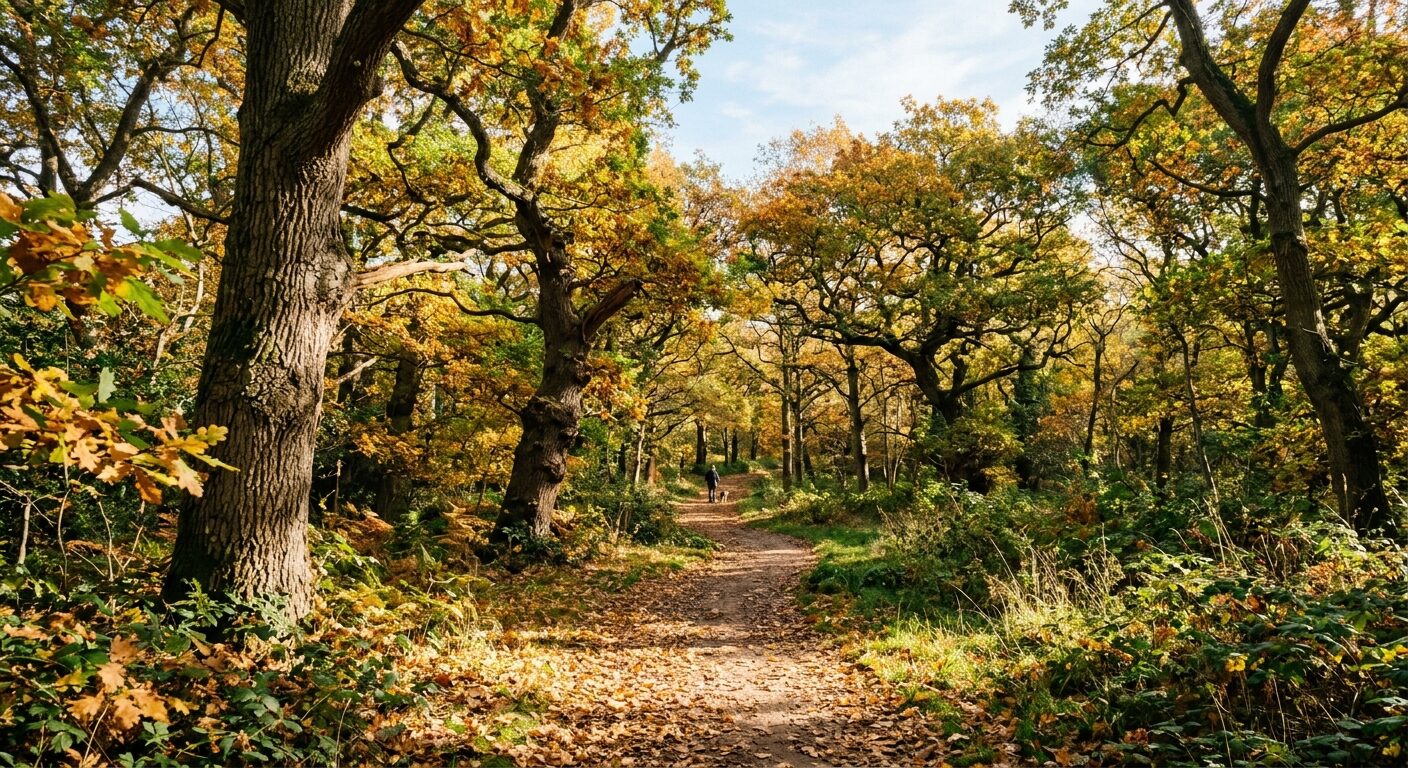
Perched along the ridgeway just eastward of Norbury’s residential avenues, Biggin Wood is one of South London’s most precious and enduring natural sanctuaries. Spanning approximately 13 acres (5.3 hectares) across the rolling terrain between Hermitage Lane and Covington Way, this quiet municipal green space is a surviving fragment of the historic Great North Wood—the sprawling, ancient oak forest that once blanketed the high ground from Croydon to Deptford and Camberwell.
While generations of SW16 commuters pass near its wooded fringes along Hermitage Lane each day, Biggin Wood offers residents an intimate glimpse into the landscape of pre-industrial Surrey, combining ancient woodland ecology with local agricultural and civic history.
From Mediaeval Forest to Manorial Woodland
Historical records reveal that Biggin Wood has stood continuously wooded for many centuries, earning it designation as an ancient semi-natural woodland. In the mediaeval period, the woodland formed part of the substantial estates belonging to the Archbishops of Canterbury, whose summer palace stood at Croydon.
The name “Biggin” itself carries deep local roots, thought to derive from a Middle English term for a building or habitation, linked to the historic Biggin Farm and manor house that once stood nearby on the hillside. For centuries, the woodland was actively managed through traditional coppicing and wood-pasture: towering pedunculate oak standards were preserved to provide timber for construction and shipbuilding, while an understorey of hazel, hornbeam, and sweet chestnut was periodically cut to produce fencing, stakes, and charcoal.
Wildlife and Ecological Significance
Because the woodland soils have never been ploughed or built over, Biggin Wood supports a complex woodland ecosystem recognised by Croydon Council and environmental bodies as a Site of Nature Conservation Importance (SNCI). Notable ecological features include:
- Veteran Trees: Ancient pedunculate oak standards form a high canopy, complemented by mature field maple, hornbeam, sweet chestnut, and ash trees.
- Ancient Woodland Indicators: The woodland floor preserves characteristic indicator plants, including dense carpets of native English bluebells (Hyacinthoides non-scripta) each spring, wood anemone, and yellow archangel.
- Bird and Mammal Life: The mixture of mature hollow trees and fallen deadwood provides vital nesting habitat for all three British woodpecker species (great spotted, lesser spotted, and green woodpeckers), treecreepers, tawny owls, and numerous bat species foraging along the leafy rides.
From Private Country Estate to Public Nature Reserve
In the nineteenth century, Biggin Wood belonged to the private grounds of Biggin House. As late-Victorian and interwar residential development swept southward from London Road across Norbury and Upper Norwood, there was significant risk that the woodland would be parcelled up and lost to speculative housing.
Recognising its environmental and scenic value, the local municipal corporation stepped in during the 1930s to acquire the land, ensuring that it was permanently dedicated as a public open space for local health and recreation. Today, the reserve is maintained by Croydon Council in partnership with local volunteer conservation groups, who help manage paths, monitor bird nesting boxes, and control invasive plants to protect the native canopy.
Practical Visitor Guide for Norbury Residents
- Location: Entrances are situated along Hermitage Lane (approaching from Norbury / Streatham) and Covington Way, London SW16 / SE19.
- Walking Distance: Approximately 15 to 20 minutes on foot eastward from Norbury National Rail Station via Green Lane or Norbury Court Road.
- Public Transport: Serviced by nearby bus routes including the 250, 50, and 109 stopping along Green Lane and London Road, as well as routes connecting through Streatham Vale and Upper Norwood.
- Amenities and Access: Biggin Wood features unpaved, natural woodland earth trails with gentle slopes. Sturdy walking footwear is recommended during autumn and winter months when trails can be muddy. Dogs are welcome on leads.
- Visiting Etiquette: As an ancient nature reserve, visitors are asked to remain on established woodland trails to prevent trampling fragile woodland flora and soil compaction around veteran tree root systems.