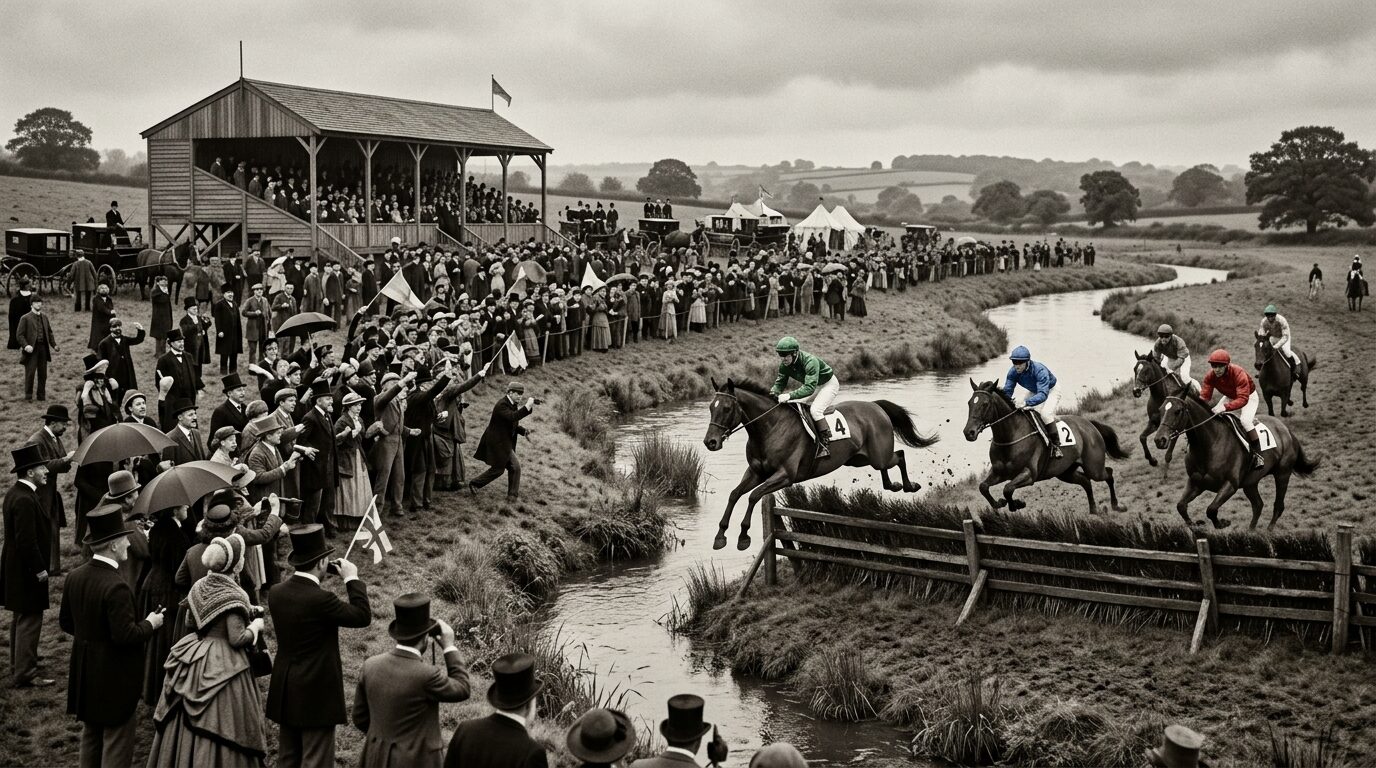
Long before suburban avenues and red-brick Edwardian villas covered the low meadows west of London Road, Norbury was the lively home of Victorian London’s most notorious sporting spectacle: the Streatham Races. Between 1868 and 1878, tens of thousands of racegoers, bookmakers, and Londoners flocked to the pastoral boundary between Croydon, Wandsworth, and Mitcham, transforming quiet countryside meadows into a roaring steeplechase hub.
While today's commuters step onto Southern trains at Norbury Station without a second thought, few realise that the railway station itself—and the residential streets surrounding it—owe their very existence to this forgotten decade of suburban horse racing.
From Quiet Farmland to 100-Acre Steeplechase Course
Throughout the mid-nineteenth century, western Norbury was largely open agricultural countryside known as Lonesome Farm, watered by the meandering course of the River Graveney. In 1867, the Croydon Steeple Chase and Hurdle Races Committee leased approximately 100 acres of this pasture to create a purpose-built steeplechase ground.
The course was laid out across the land bounded today by Northborough Road, Stanford Road, and Rowan Road. A wooden grandstand and paddock were constructed near the modern junction of Northborough Road and London Road. The steeplechase circuit took direct advantage of the local landscape: thoroughbred racehorses had to tackle substantial natural brush hurdles and an open water jump directly across the River Graveney.
The 1878 Opening of Norbury Station
The Streatham Races quickly became one of the most popular sporting events on the fringe of the capital. Meeting four to five times a year—often over three lively days in spring and autumn—the races drew enormous crowds traveling out from central London.
Although the railway line from Victoria through Balham towards Croydon had opened in 1862, trains initially passed through the rural meadows of Norbury without stopping. By 1877, the sheer volume of racegoers and horse boxes travelling to Lonesome Farm prompted the London, Brighton and South Coast Railway (LB&SCR) to act. In January 1878, the company opened Norbury Station (originally constructed as a timber halt), designed specifically to set down spectators and racehorses directly beside the course.
Parliamentary Intervention and the Act of 1879
As the Streatham Races expanded, so did local controversy. Victorian moral reformers, affluent villa residents on Streatham Common, and local clergy grew increasingly vocal about the massive crowds, illicit bookmaking, alcohol stalls, and disorderly scenes that accompanied each race meeting.
The agitation reached the halls of Parliament. In 1879, lawmakers passed the Racecourses Licensing Act 1879, which prohibited unlicensed horse racing within a 10-mile radius of the Palace of Westminster. Unable to secure municipal licensing under the strict new legislation, the Streatham Races held their final meeting in November 1878 and closed permanently.
Traces of Racing Heritage in Modern Norbury
The closure of the racecourse cleared the way for the rapid suburban growth that shaped modern Norbury SW16. With the newly opened railway station already providing direct commuter access into London, developers quickly purchased the former racecourse and farm estates, laying out residential roads, schools, and commercial parades along London Road.
Today, subtle reminders of Norbury’s racing chapter remain hidden in plain sight:
- The Railway: Norbury Station stands on the exact site chosen in 1878 to serve the racecourse crowds, rebuilt in 1902 to accommodate the suburban commuter boom that followed.
- Street Alignment: The layout of roads between Northborough Road and Rowan Road follows the perimeter and drainage boundaries established during the 1860s racing lease.
- The River Graveney: The watercourse that once provided a challenging steeplechase obstacle continues to flow quietly through western Norbury and neighboring Merton.
Next time you catch a train from Norbury or stroll down Northborough Road, remember the thunder of hooves that once echoed across Lonesome Farm—the short-lived sporting chapter that helped put Norbury on the London map.